Showing posts with label carrot. Show all posts

Tuesday, March 15, 2011

March!


March is a funny month for me. It is the transition month between the two gears in my life: "winter" and "farming". Years like this, March is a little easier becuase there is still so much snow on the ground. Meaning--the indoor to do list is still long, and I may have a chance to get to it since the outdoor to do list is still buried in snow. But I am definatly being pulled into spring--1000's of onion, lettuce, cabbage, kale and chard seeds have been sown at the greenhouse! No germination quite yet, but soon, very soon.

This is the month I start to really push my marketing....if you haven't signed up yet for 2011...I go to CSA fairs and Wellness fairs, post brochures, hang fliers...and basically talk my head off about why joining Little Ridge Farm CSA could possibly be the best decision you will make all year. Thank you to all of you talking heads as well! Word of mouth by far is the biggest and most successful advertiser.

I have decided to grow in number by about 15 shares this summer and increase the winter shares from 40 to 50 and raise the pigs by 2. Already I have 50 of the 75 summer shares I would like and have sold out on all the pigs and beef! It is hard for me to say no to people. I find myself thinking, okay maybe I should get more pigs or increase this, increase...It is good to know that demand is high, but I need to be sure I can keep the quality of my product and my life high as well. Small steps. Part of me wants to raise food for 125 shares, with 20 pigs and cows and turkeys and...but part of me likes the little family we have created thus far, small but healthy.


Just say "YES!" to spinach. Although I think I broke my back shoveling and didn't sleep as much due to wind/snow load worry, I think the hoophouse has been a success. I learned a few things this year and will try and improve for next. I hope you all have enjoyed the sweet little treats of green.
This week looks like it be a bit warmer and SUNNY on Thursday for pick up! The winter shares have been a lot of fun for me, I think a good decision to do this instead of the farmer's market. More my style.
CANNING WORKSHOP!!!!
In my kitchen during pick up March 17th.
Pat, a volunteer from UMaine Extension, will be making blueberry jam. Stop in to see how it is done, ask questions and receive paper print outs!
This months share: winter roots, the last of the winter sqash, fresh spinach and a surprise : )
Recipe:
Carnival Winter Squash:
This small colorful squash has a mellow flavor, similar to a sweet potato. You can stuff it, use it as a base for soups or mix it with butter as a side dish. The skin is hard, so you will want to bake it first before scooping out the meat.
Winter Root Vegetable Slaw Recipe
The choice of root vegetables here works well, but you are free to mix and match. Just be sure to not have too many sweet vegetables like carrots and parsnips, or too many sharp ones, like radishes or turnips.
Ingredients
· 1 teaspoon Dijon mustard
· 1 teaspoon salt
· 1 teaspoon sugar
· 1/4 cup sherry or red wine vinegar
· 1 cup chopped parsley, loosely packed
· 2/3 cup olive oil
· 2 large carrots (choose different colored carrots if you can find them)
· 2 medium parsnips
· 1 small celery root
· 2 black radishes or 1/2 daikon radish
Method
1 Put the mustard, salt, sugar, vinegar and parsley in a blender and process until combined, about 30 seconds. Scrape down the sides of the blender, cover and process at its slowest setting. Drizzle in the olive oil slowly. When it is all in, move the blender to its highest setting and puree for about 90 seconds.
2 Peel all the vegetables except for the radishes, if you are using black ones. The slivers of black in the salad look cool, so I leave them in. Using a vegetable peeler or a coarse grater, slice shreds off the vegetables into a bowl. Try to keep the shreds roughly the same length if you can.
3 To finish, toss some of the vinaigrette with the shredded vegetables and let stand in the fridge for at least 20 minutes before serving.

Monday, October 25, 2010

Week 23 Oct 26th and 29th

THE LAST PICK UP...CLEANING OUT THE FIELDS

This week, you may see some strange looking vegetables in the share. These crops are able to withstand the colder temps and actually get sweeter with frosts, so I have left them for the very end.
Purple Kohlrabi: I blogged about kholrabi earlier in the summer. This is very similar, just purple. It has a sweet "broccoli stem" flavor, that you may want to cook or eat raw.
Fennel: This cool looking vegetable is Mediterranean in origin and has a unique anise, or black licorice flavor. Again, it may be eaten cooked or raw. It aids in digestion and packs in Vitamin A, calcium, potassium and iron.

Brussel Sprouts: I didn't take a photo. I should have , they look like a little pineapple plantation out there in the field. You will sort of get the idea of how they grow when you see them at pick up. I leave them on the stalk because they store better that way. Just before you eat them, "snap" the sprouts off the stem, clean off any yellowed leaves and prepare. They are not your school cafeteria sprouts! Just be careful not to over cook them.

Delecata Squash: Many of you have been waiting for this sweet little winter squash. It is small but flavorful and makes a great soup, sauteed veg, roasted veg or baked and stuffed. The skin is so thin and "delicate" that you can eat it after cooked! Check out the Delecata squash bisque recipe posted on the blog last October.

A big thank you and blessing to the turkeys and cows!

So this is it, the last pick up of a long and extremely productive
season. Thank you all for your support, and love for fresh food. I
had a super time growing this year and loved meeting all of you and your families. Many of you I will see during the winter share pick ups, but if
not, happy winter and I look forward to seeing you again in the spring! Be sure to sign up for the 2011 season soon after the New Year.

The Last Week's Loot: carrots, chinese cabbage, brussel sprouts, kohl rabi, daikon radish, kale, chard, fennel, delecata squash, spaghetti squash/pumpkin, onions, leeks, oregano, thyme, sage (sorry no taters, I need them for winter).
Recipes
Fennel, Carrots and Pecans
2 cups carrots, cut into matchsticks
1 Tbs olive oil
1/2c thinly sliced fennel
1/4c maple syrup
1/4c roasted pecans
2tsp cornstarch
1Tbs chopped parsley
Steam carrots until tender-crisp. Heat oil and saute fennel 2 minutes. Add syrup, pecan and carrots, and simmer briefly. Mix cornstarch and 1 Tbs water and stir into skillet. Stir in parsley and serve.
Brssuel Sprouts in Cider with Apples and Onions
1 lb brussel sprouts, halved
2 apples, 1/2 in cubes
2 Tbs butter
2 Tbs olive oil
1 red or yellow onion, chopped
1.5c cider
1/2tsp salt
1/2tsp pepper
2 star anise (could use a little fennel)
1/4c balsamic vinegar
Melt butter and oil in pan on low. When foams turn up to medium and add apples and onions, saute til apples soft and onion clear, bout 4 min. Add sprouts, cook about 3-4 min. Add remaining ingredients cept vinegar. Cover, reduce heat and simmer til sprouts are easily pierced with a fork, bout 10 min. Remove contents with a slotted spoon and place in a serving dish. Heat reserved liquid until reduced by half, add vinegar, cook 2 min stirring and scraping pan, pour over sprouts
Baked Kohlrabi
1 fennel bulb
2 c kohlrabi, sliced 1/2 in thick
2 cups stock
1/3 c milk or half and half
3 Tbs butter
2 Tbs flour
1/4 c parm
1/2 tsp paprika
Heat over to 350. Slice fennel 1/2 thick. Bring stock to a boil and add veg and cook til tender 7-10min, Drain, reserving stock. Add enough stock to milk to total 2 cups. Heat 2 Tbs butter stir in flour and cook 2 min. Whisk in stock until smooth. Season with slat and pepper. Butter a casserole dish and place veg in pan. pour sauce over it, sprinkle with parm and bake 1/2 hour

Monday, October 18, 2010

Week 22 Oct 19th and 22nd

WINTER ROOTS
This year I experimented with growing vegetables for the Crown of Maine Organic Cooperative. Crown of Maine is a local coop that buys food from farms and resells it to restaurants, grocery stores and food coops. I have really enjoyed selling to them as I feel they are in tune with us farmers and give really fair prices. Anyway, this year I grew colored carrots and winter radishes for them. These are the only 2 crops that you will get "2nds" as Crown of Maine gets the perfect looking stuff. You have already seen the colored carrots and this week I will introduce the winter radishes!

From left to right: Daikon, Saisai Leaf, Green Meat, Munchener Bier, Nero Tundo

Daikon: An Asian root, crisp and full of hot flavor. Cooking mellows the heat. Used mostly in making kimchi, a pickled root dish.

Saisai Leaf: This root is very similar to the daikon, but a little plumper. It was bred so that it leaves could be harvested for salads, stir-fries and pickling. I didn't try any leaves this year, maybe next.

Green Meat: Unique miniature daikon. Crisp and "sweet".

Munchener Bier: Germans traditionally serve this mildly pungent radish sliced thin and salted with a dark beer. Try them sauteed and salted too.

Nero Tundo: Black radishes have been traced back to the 16th century conquistadors. Pungent white flesh loses some heat when boiled or stir-fried.

Radishes are exalted for their many nutritional supplements and vitamins.

--Radishes, especially black ones, contain a unique phytochemical called MIBITC that is even stronger than the much-lauded anti-cancer compound sulforaphane, which is found in broccoli.

--radishes are rich in vitamin C, the B vitamins and sulfur.

--The radish root can also be crushed and used as a poultice for burns, bruises and smelling feet.

As for eating, well...your imagination is your limit!

All of these radishes may be cooked, eaten raw, grated or pickled. Most are quite spicy (especially since it was so hot and dry), but flavor mellows or sweetens when cooked. Grating them onto salads or on top of soups adds nice flavor, but not too much spice all at once.

According to several online recipes, winter radishes work very well peeled, chopped into matchstick-sized pieces and cooked in stir fry dishes. They can also be thinly sliced, baked and eaten as "chips" or grated and mixed with sour cream and lemon juice as a salad/side dish.

Gilfeather Turnip This heirloom "turnip" (it's actually a rutabaga) is sweeter than most turnips. It is wonderful grated with carrots or roasted in a pan. It was either developed or discovered by a lanky secretive bachelor, John Gilfeather, in VT who was said to have cut off the tops and the bottoms so that no one else could propagate them. However a few seeds escaped and were eventually commercialized. This year will be the 8th annual Gilfeather Turnip Festival in Mt Snow Vermont!

Inca and Pedro have started to explore the outdoors. They were so cute with the ducks. I think Inca has potential to be a duck herding cat!
This Week's Loot: lettuce/spinach mix, winter radish, leeks, onions, potatoes, carrots, beets, cabbage, chard
Next Week's Loot: greens of some sort, delicata squash, onions, carrots, potatoes

Recipes:

Radish and Root Kimchi --Wild Fermentation, Sandor Katz, an awesome book
Ingredients for 1 qt
2 daikon
2 turnips
3 carrots
a few small red radishes
3 Tbs or more fresh ginger root
3 clove garlic
2 onions/leeks
3 hot peppers or more

Process:
1. Mix a brine about 4 cups water and 3 Tbs salt
2. Slice roots, leave on skins.
3. Place them in the brine and place a plate on them to make sure they are fully emerged overnight
4. Prep ginger, peppers, garlic
5. Drain brine off veg., reserving brine, you want it to taste salty, but not unpleasantly so. If too salty, rinse. If not salty enough sprinkle with a couple tsp and mix
6. Mix spices into veg and stuff into a quart jar. Pack tight, until brine rises, if you need to add reserved brine to cover veg do so. Place something on veg so it stays immersed and cover it with a towel to keep off dust and flies.
7. Place jar in a warm place. After about one week, place jar into fridge to slow fermentation down. You may also taste kimchi daily and place it in the fridge when you think it tastes ready.

CIDER SCALLOPED GILFEATHER TURNIPS
2 tablespoons flour
1 cup apple cider or juice
½ teaspoon salt
1/8 teaspoon nutmeg, ground
½ cup Jarlsberg cheese, shredded
1 cup milk
½ cup chicken broth
¼ teaspoon black pepper, ground
½ cup cheddar cheese, shredded
2 lbs. Gilfeather turnips, peeled and thinly sliced
Heat oven to 425 degrees F. Put oven rack in center position. Grease 10 x 2 round baking dish or an 8 x 10 rectangular baking dish; set aside. Place flour in a medium heavy saucepan; gradually add milk, whisking until smooth. Whisk in cider, broth, salt, pepper and nutmeg. Bring mixture to a boil over high heat, whisking constantly. Cook one minute more, remove from heat and set aside.Combine cheeses. Arrange half of the sliced turnips (slightly overlapping) in prepared baking dish. Sprinkle half of cheeses on half of the turnips. Arrange another layer of turnips on top of cheese. Pour cider mixture over turnips.
Golden Winter Soup
Leeks and potatoes provide the base for this hearty vegetable soup, and butternut squash adds a hint of sweetness. Gruyère toasts add a salty note.

2 tablespoons butter
5 cups (1/2-inch) cubed peeled butternut squash (about 1 1/2 pounds)
2 cups (1/2-inch) cubed peeled russet potato (about 12 ounces)
1 teaspoon kosher salt
1/2 teaspoon freshly ground black pepper
2 cups sliced leek (about 2 medium)
4 cups fat-free, less-sodium chicken broth
1 cup half-and-half
12 ounces baguette, cut into 16 slices
3/4 cup (3 ounces) shredded Gruyère cheese
3 tablespoons chopped chives
Freshly ground black pepper (optional)

Preparation
Preheat broiler.
Melt butter in a large Dutch oven over medium-high heat. Add squash, potato, salt, and pepper to pan; sauté 3 minutes. Add leek; sauté 1 minute. Stir in broth; bring to a boil. Reduce heat, and simmer 20 minutes or until potato is tender, stirring occasionally. Place half of potato mixture in a blender. Remove center piece of blender lid (to allow steam to escape); secure blender lid on blender. Place a clean towel over opening in blender lid (to avoid splatters). Blend until smooth. Pour into a large bowl. Repeat procedure with remaining potato mixture. Stir in half-and-half. Cover and keep warm.
Arrange bread slices in a single layer on a baking sheet; sprinkle evenly with cheese. Broil bread slices 2 minutes or until golden. Ladle 1 cup soup into each of 8 bowls; top each serving with about 1 teaspoon chives. Serve 2 bread slices with each serving. Garnish with freshly ground black pepper, if desired.

Saturday, July 31, 2010

Week 11 Aug 3rd and 6th

Potatoes, Spuds, Taters


This amazing root vegetable grows beautiful bulbs of red, yellow, purple, blue, white and brown. Mostly I dig potatoes by hand: pulling up a plant and then immersing my hand into the soil sifting for "gold". A good yield is harvesting 10# of taters for every 1# planted. I don't know that my yield is quite that high, but it is pretty darn good.


When you look at the potato, you will see little "eyes" or sunken spots on the tuber. It is from these eyes that a potato sprouts a branch. In early May, I set a piece of a potato, about the size of an egg, into the ground and cover it with about 4 inches of soil. Soon, those eyes have set branches and eventually they poke out of the soil. At 6 inches tall, I mound more soil up around the branches and then once again when they are 12 inches tall. This gives a nice soft mound of soil for the potatoes to grow in which makes harvesting easier.


The potatoes you are receiving now are considered "new potatoes". That means that their skin is thin and that they would not store for a long time outside of your fridge. Some potato varieties are good "storage potatoes". These varieties I let stay in the ground until their leaves naturally die. This is an indication that the skins on the potatoes have toughened up and cured so that they will be able to store for up to several months. These potatoes I will not wash for you, as they are best stored unwashed in a dark, cool, dry place.

"The annual diet of an average global citizen in the first decade of the twenty-first century included about 73 lb of potato."


A Bird's Eye View
A porcupine has found the weakness in my hero farmer armor...eat right through it. This little spiky animal has consistently eaten 10-20 heads of lettuce a night. We have sat out for 4 consecutive evenings waiting for him to show his face before dark, but alas, I think the crows are alerting him to our whereabouts. They are certainly in cahoots, although I am not quite sure what the crows are getting out of the deal. Maybe the porcupine promised to stay out of the tomatoes if he could get all the lettuce he wanted. Well their little conspiracy is working...bummer!

Dilly Beans, Frozen Beans, Pickles, Zucchini Relish
Let me know if you are interested in aquiring more cucs, zucs and/or beans for preserving!


This Week's Loot: Lettuce? Cucs, Zucs, Green Beans, New Potatoes, Kale, Herbs, Jalepeno Peppers, Corn?

Next Week's Loot: Lettuce? Cucs, Zucs, Green Beans, Carrots, Beets, Green Peppers?

Recipes:
Vegetable Lasagna
Basically just layer every vegetable you get into a pan...beans, squashes, greens, carrots
In between layers add cheese, oil, herbs, sauce...
Bake it covered at 350 for 30 minutes, then remove cover and bake until cheese is bubbly

Thursday, June 24, 2010

Week 6, June 29th and July 2nd

Chard
The variety of chard I grow is called "bright lights". It is a beautiful addition to the garden...and even your flower garden. It is in the same family as spinach, so it is similar in flavor. I can cut this crop and it will regrow again and again throughout the season.

How do I eat chard? The smaller leaves can be cut up and eaten raw in your salads. Other wise, light cooking is good. You may use any of the greens recipes given out thus far.

What are the nutritional benefits of Swiss Chard?
High in Dietary Fiber, Vitamin A, Vitamin C, Vitamin E, Vitamin K, Riboflavin, Vitamin B6, Calcium, Iron, Magnesium, Phosphorus, Potassium, Copper, Manganese, Thiamin, Folate and Zinc. Also high in Sodium
.
How do I store chard? You guessed it...crisper


Surfin' Simon! We went to the beach this weekend!!!

PYO Strawberries!!!

I hope you all enjoyed your quart of strawberries last week!!! I was pleasantly surprised picking, there are more berries than I anticipated and boy are they yummy! There are 3 different varieties: earliglow, honeyoye and jewel. Earliglow was hit the hardest in the freeze since it is the earliest. It is by far the best tasting, but you will find several small and "buttoned" berries due to freeze damage. They are still edible, just a bit more work : )


PYO Flower Garden
The Pick Your Own garden is starting to blossom! Feel free to wander the garden and start to pick things like: snow peas, daisies, marigolds and basil.
Please do not pick the rhubarb (it's the only thing that is not PYO, it just happens to be where I planted it--sorry)
This week's loot: lettuce, baby carrots (with tops--they make a yummy soup), chard, radish, tat soi, shell peas!, garlic scapes, mint, lemon balm, tarragon


Next week's loot: lettuce, baby carrots, baby beets, kale, shell peas, scallions, new potatoes?
Recipes
Lemon Balm and Mint--This herbs are very versatile! You can use it in your meals or to make a refreshing sun tea...thought it would be perfect for the 4th of July picnics!
A little mint in fruit salad can dramatically change its flavor. Mint can also work well in green salads. A little mint and peanuts will give a salad a Southeastern Asian appeal. The herb is also commonly used in Middle Eastern food. One can garnish hummus with mint, or add a little chopped mint to tabbouleh. Mint mixed into couscous can enliven this otherwise plain grain derivative.
Cooked veggies like peas, corn and carrots can all be infused with mint flavor. A minute prior to ending cooking, add a mint leaf or two to these steamed vegetables. Remove the leaves before serving and you’ll have a new way to make these classic vegetables appealing.
Mint marinades or chopped mint goes very well with certain meats. Lamb is often served with mint, and is best known. Mint also complements certain types of seafood like lobster, scallops, and sole. Consider mint chutney with these, or lobster dipped in mint garlic butter.
If you enjoy Vietnamese food, don’t leave out the mint. Many of the “make your own” rolls served in Vietnamese restaurants include thin rice pancakes, strips or balls of cooked meat, and a beautiful pile of fresh herbs and dipping sauce to add together for an Asian style burrito. A little mint in Thai or Chinese egg rolls can also change the taste, or savory egg rolls could be dipped in a mint sauce. A tiny amount of chopped mint can garnish scrambled eggs, omelets, or egg foo yung.
loosely wrapping them in a towel and storing them in a crisper in the fridge, away from the fan. Freshness is key; tarragon loses its flavor as it dries out.
Tarragon works well in chicken, egg and fish dishes, and in cream or mustard sauces. I've even used it in soups with some success (it does tend to be a bit strong for very delicate soups). While the weather is still hot, try it in this cold Creamy Spinach and Tarragon Soup. Adventurous cooks should try it in a sorbet, like the one I mentioned above, or in this lovely, refreshing Tarragon-Spiked Lady Grey Iced Tea from Gourmet magazine.
Spaghetti with Swiss Chard and Garlic Chips
Gourmet, November 2008
Makes 4 to 6 servings
1/3 cup extra-virgin olive oil
1 head garlic, cloves peeled and thinly sliced lengthwise (or use scapes!)
1 medium onion, finely chopped
1/2 cup dried currants (we skipped this)
2 pounds green Swiss chard, stems and center ribs finely chopped and leaves coarsely chopped separately
1/2 cup water
1 pound spaghetti
1/2 cup Kalamata olives, cut into slivers
6 ounces feta, crumbled (1 1/2 cups)
Heat oil in a 12-inch heavy skillet over medium heat until it shimmers, then cook garlic, stirring, until golden, about 3 minutes. Transfer garlic with a slotted spoon to paper towels to drain.
Cook onion in oil remaining in skillet over medium heat, stirring occasionally, until softened, 3 to 5 minutes. Add currants and cook, stirring, until plumped, about 1 minute.
Stir chard stems into onion mixture with water and 3/4 teaspoon each of salt and pepper. Cook, covered, over medium-high heat until almost tender, about 5 minutes. Stir in chard leaves and cook, covered, until stems and leaves are tender, about 5 minutes.
Meanwhile, cook spaghetti in a pasta pot of boiling salted water (2 tablespoons salt for 5 quarts water) until al dente. Reserve 1 cup pasta-cooking water and drain spaghetti.
Toss spaghetti with chard, olives, and 1/2 cup cooking water, adding more cooking water if necessary. Season with salt and pepper. Serve sprinkled with feta and garlic chips.

Swiss Chard SaladIngredients
2 tablespoons extra-virgin olive oil
4 cloves garlic, minced
1 bunch Swiss chard, cut into wide ribbons
1/4 cup balsamic vinegar
salt and pepper to taste
Directions
Heat the olive oil on a large skillet over medium heat. Stir in the garlic and cook until tender and aromatic, about 2 minutes. Add the Swiss chard and balsamic vinegar; cook and stir until the chard is wilted and tender, about 5 minutes. Season with salt and pepper and serve.
Carrot Top Soup [serves 4] (there are several carrot top soup recipes on the web, check em out!)1 bunch carrots, including the greens
1/2 cup brown rice
1 or 2 garlic scapes
6 cups water, light chicken stock, or vegetable stock
thyme, to taste, and whatever other herbs suit your fancy (the Valymyst
Herb blends work great in this)
salt & pepper, to taste
In a small saucepan, bring 3/4 cups water to a boil. Add rice. Simmeruntil tender, and set aside. While the rice is cooking, pluck the lacyleaves of the carrot greens off their stems, enough for 2 to 3 cups,loosely packed. Wash thoroughly, then chop finely. Chop the carrotsinto fairly small pieces.
Melt a couple tablespoons of butter in a soup pot. Add the carrot topsand carrots, garlic and herbs. Cook for a few minutes, turningeverything a few times, then add the water or stock, and salt. Bring toa boil, and simmer until the carrots are almost cooked. Add the rice,heat through until the carrots are tender, then taste for salt andseason with pepper.

Monday, May 17, 2010

The First Pick-Up

Weather

A few weeks ago I was asked "what is the most challenging thing about farming?" Without hesitation, I responded "the weather". If it's not too wet, it is too dry, if it's not too hot, it is too cold, if there's not a nice breeze to waft the black flies away, it is gusting 50mph, and so on. I hate to say it, but I wish we could have a little rain. A normal amount, like a nice soft inch per week. We are planning on a little irrigation for the driest fields in the driest months, but we aren't quite there yet. The other bonus to having irrigation would be to save the tender strawberry flowers when a frost threatens. Unfortunately, we got down to 22 degrees here last week and 90 percent of the strawberry flowers froze. That means no berries : ( Well, hardly any. We are hoping for a few handfuls...


Ahhh, okay, on to brighter things! Even if we did have an early spring coupled with a late frost, I will take this spring over last year's any day! Milo is enjoying this fine spring. He rests while I work, he thinks it is a purrrrfect arrangement. Thank you for supporting our farm--we hope the season surpasses your expectations.


Mid Coast Growers
Rt 125, Bowdoin
Many of you know that I do not have a green house yet. So I have been renting space at a greenhouse just 7 miles away in Bowdoin. It has been a great deal for me. I usually go in twice a week and seed and/or transplant things, then while I am back here cultivating the soil, Dale is at the green house watering my plants whenever he waters his. This spring it was a wee bit tight for space, but I think we were both happy with spring bursting at the seams.
Hanging baskets from Dale will be here for sale at the farm $25 each--they are gorgeous!


He has three HUGE greenhouses...here is my little square of plants : ) They have beautiful neighbors!
Well this week's loot will be light, but hopefully very tasty. We will take a few weeks' break and then resume the second week of June. I will be in touch to let you know dates...until then enjoy and Happy Spring!!!
Asparagus--the first year I could pick! (they are only 3 year old plants)

Winter Carrots and Parsnips--These sweet guys were in the ground all winter

Rutabagas--The wonder of all root storage crops!

Rhubarb--The spring "fruit"

Sorrel--A lemony spring green, great with fish or in soups, or with eggs!

Chives--Use a bunch, just like onions, raw or cooked
Hamburg Parsley--This is a root that tastes just like parsley! You can shred it and eat it raw, or chop it up and cook it wherever you want that fresh parsley flavor

Sorry no greens. I decided to let them get a bit bigger, so you can enjoy them in June : )

Recipes:

http://smittenkitchen.com/2009/04/simple-potato-gratin/ The Smitten Kitchen...it has been my new favorite blog for recipes. This one is for potato gratin, but check out the bottom for "more gratin ideas" she uses, sorrel, parsnips...I bet you could even use rutabagas!

Rhubarb--There are loads of sweet breads and cobblers you could make with rhubarb, but my favorite thing to do is to eat vanilla ice cream with rhubarb sauce...

chop the rhubarb
place it in a saucepan
add just a, 1/8" of water to pan
on low/med heat the rhubarb til it falls apart and makes the consistency you want for your sauce...you can even add a touch of maple syrup

Sorrel Omelet
4 eggs
1 tablespoon cream
1 cup sorrel, cleaned and shredded
2 tablespoons butter, divided
1/4 tsp salt
In a heavy pan, heat half the butter and add sorrel and salt. Cook for about ten minutes, while stirring. Combine the eggs and cream in a bowl, beating gently. Add the sorrel mixture and combine. Add the remaining butter to a skillet and heat until butter is slightly browned. Add the egg mixture and stir briskly with the back of a fork or spoon until the eggs are evenly spread on the bottom of the skillet. Keep moving the unset eggs around with the utensil smoothly until there is no liquid left. Do not overcook. Shake the pan gently over the heat a few times. Fold the omelet over in half and serve.
Sorrel Soup:
1/2 pound sorrel
2 tablespoons butter
6 cups water
1/2 pound potatoes, peeled and quartered
2 tsp. salt
1 cup milk
1 egg yolk
Clean and shred sorrel, then chop. In a large heavy pan, heat butter. Add sorrel and cook, stirring, for ten minutes until reduced to about 1/2 cup. Add the water, potatoes and salt. Bring to a boil. Cover and simmer for 1/2 hour. Strain and mash or puree the vegetables. Stir the cooking liquid into vegetables and return to pan. Bring to boil. Stir in milk and yolk. Cook until hot, but do not boil.
Lentil Soup with Parsley Root and Carrots
1 lb Dried lentils, -washed and drained
1/4 c Lard, bacon drippings, -or oil
2 md Onions or leeks, chopped
1 parsley root or parsnip, chopped
2 md Carrots, sliced
1 c Sliced fennel or celery
8 c Water
1 t Salt to or to taste
Several whole black pepper-corns
2 Whole cloves
2 Bay leaves
1 lg Potato, peeled and grated
2 lg Links (or 4 small) smoked -sausage, skin pricked-with fork
2 tb Good vinegar
In a large pot, heat fat and add carrots, root vegetable and onions. Saute until onions are golden. Add lentils, water, celery, and seasonings. Grate the potato into the mixture and add sausage. Simmer covered 1 hour until lentils and vegetables are tender. Remove bay leaves. Add vinegar just before serving and adjust salt. Serve with a crusty bread and salad. Serves 4-6

Monday, September 7, 2009

Week 14--The Beauty of Food

How lucky I am to have such beautiful food to eat on a daily basis

--

and to have a husband that cooks!
So this week the melons are ripe and you all should get one--I promise : ) The tomatoes on the other hand are at the end of their rope. This week I will harvest every last healthy tomato and then rip out the plants. May we never be cursed with late blight again!! I am thankful though that we had as many tomatoes as we did. Summer wouldn't be complete without at least one!


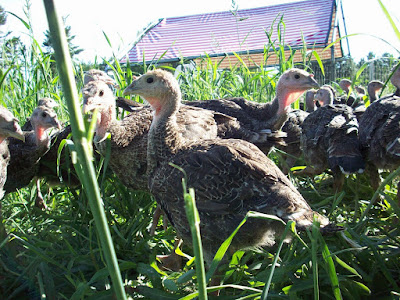
The turkeys are enjoying their grass. When I move them, I just let them roam free. They love it! And thankfully Simon just lets them be. If I could get him not to eat peoples' arms and shoes when they walk, I think he would be the perfect dog : )

Sherrie Blumenthal and Denise Dill (LRF sahreholders!) traveled to Michoacan, Mexico, the final destination of the Monarchs after their 2000-mile journey. The women will talk about their trip after a showing of the film "The Incredible Journey of the Butterflies," a 2009 PBS NOVA documentary at 6:30 p.m. Wednesday, Sept. 9, at the library. http://www.sunjournal.com/node/271758
This Week's Loot: Carrots, Beets, Cucs, Zucs, Potatoes, Edemame, Lettuce, Cabbage, Tomatoes, Melons, herbs

Next Week's Loot: Leeks, Potatoes, Cucs, Zucs, Spaghetti Squash, Tomatoes?, Melons, Lettuce, Herbs

Crash Hot Potatoes
Boil potatoes until fork tender

Spread olive oil on a cookie sheet

Place the potatoes on the sheet, leaving space between each one

Use a potato masher and press down on the tater, turn masher 90 degrees and mash again

Brush olive oil on tater

Sprinkle with salt, pepper and herbs lice rosemary, chives...

Bake for 20-25 minutes (or until crispy and sizzling) at 450--YUM!


Coleslaw

1/4 mayo

1/8 red wine vinegar

Dijon mustard

pinch of sugar

salt and pepper

1/4 cup grated carrots

2 cups thinly sliced cabbage

1/8 cup red onions

Mix em all up. Taste and add more ingredients if necessary.